How to pronounce the English "th" sound
May 15, 2026 · Accent Zone Team
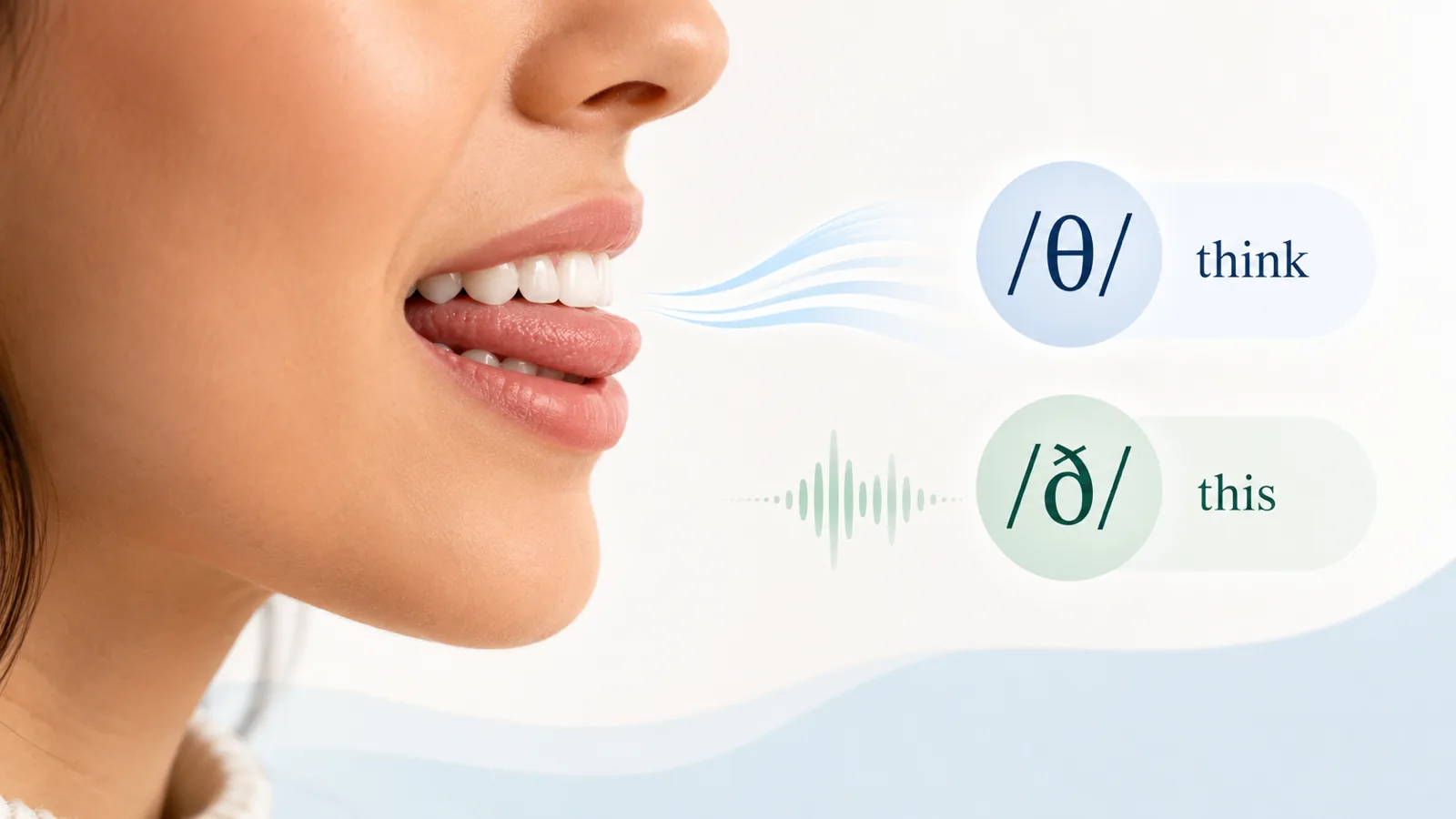
The English "th" is two sounds, not one. Most learners struggle with it for the same reason: their first language doesn't have a dental fricative, so the tongue never learned to sit between the teeth. Once you know what your tongue is supposed to do, the sound is easy. Holding it cleanly while you speak at normal speed is what takes practice.
The two "th" sounds
English uses one spelling for two distinct sounds:
- Voiceless /θ/ as in think, bath, three. No vibration in your throat.
- Voiced /ð/ as in this, brother, the. Throat vibrates.
Put your hand on your throat. Say "think". No buzz. Say "this". You should feel a buzz. That's the only difference between the two — same tongue position, voice on or off.
The tongue position
For both sounds:
- Let the tip of your tongue rest lightly between your top and bottom teeth — or just behind your top teeth, barely touching.
- Push air gently through the gap.
- For /ð/, turn on the voice. For /θ/, keep it off.
You shouldn't bite your tongue. You shouldn't push hard. If it feels effortful, you're overdoing it.
Common substitutions and why they happen
If your first language is French, German, or Russian, you probably replace /θ/ with /s/ or /t/ ("sink" or "tink" instead of "think"). Spanish speakers from most regions replace /ð/ with /d/ ("dis" instead of "this"). These substitutions are predictable: your mouth defaults to the closest sound it already knows.
The fix isn't to think harder mid-sentence. It's to drill the tongue position until it's automatic.
A 5-minute daily drill
- Minimal pairs, 1 minute. Say "think / sink", "thank / sank", "three / tree". Feel the tongue come forward each time you hit "th".
- Voiced/voiceless flip, 1 minute. "thigh / thy", "ether / either", "breath / breathe". Same tongue, voice on/off.
- Hold the sound, 1 minute. Say a long "thhhhhhh" with your tongue between your teeth. Then a long "ðððððð" with voice. You're training the position to be steady.
- Sentences, 2 minutes. "The thirty-three thieves thought they thrilled the throne throughout Thursday." Slow first. Then at normal speed.
When to stop drilling
When you can read a paragraph aloud and hit every "th" without slowing down or substituting. That usually takes a week or two of daily practice, not months. The mouth learns fast once you give it the right target.